

Not saving up ahead of your vacation is a surefire way to ruin your trip. Trust me, I’ve done it before.
Every time you swipe your credit card, it’ll stress you out. You’ll skip out on new experiences because you don’t have the cash to swing it. And you’ll spend your entire trip feeling this ominous cloud hovering over you, knowing you’ll have to face the frustrating reality of paying off that trip for months down the road.
If you want to start having the best vacations of your life, you need to learn how to save for them upfront.
Why you should save ahead of time
Saving up and paying for vacations in full is not just emotionally rewarding, it’s financially superior in many ways. Not only will you enjoy your trip more without worrying about what you’re spending, but you’ll also build more excitement as your savings pile grows. Sometimes, the anticipation can be just as enjoyable as the trip itself!
Even better, when you avoid putting expenses you can’t afford on your credit cards, you’ll save money on your vacation. When you take on debt for that getaway, high rates of interest mean you’ll pay more for that trip. And this can seriously diminish the experiences and memories. Instead of looking back on the awesome times you experienced while away, you’ll feel the total bummer of paying your trip off when you should be planning the next one. What’s the point of going away if you can’t even enjoy it?
That’s why saving up for your vacation ahead of time is just the best practice. You’ll have an infinitely better getaway and your finances will thank you!
How to Save for a Vacation
Saving ahead of time for vacations is the best way to travel. But amassing that lump sum of spending money doesn’t happen overnight. So here’s a step-by-step guide to help save for your next getaway. While none of it is overly complicated, it takes discipline, and with a little creativity, you’ll be able to save even more.
Okay, let’s get into it!
Step 1: Figure out how much you should spend on vacations
The first step towards saving up money for a vacation is figuring out how much money you can afford to spend. While vacations can be important and fulfilling, spending more than you can afford is a quick way to sour those vacation memories.
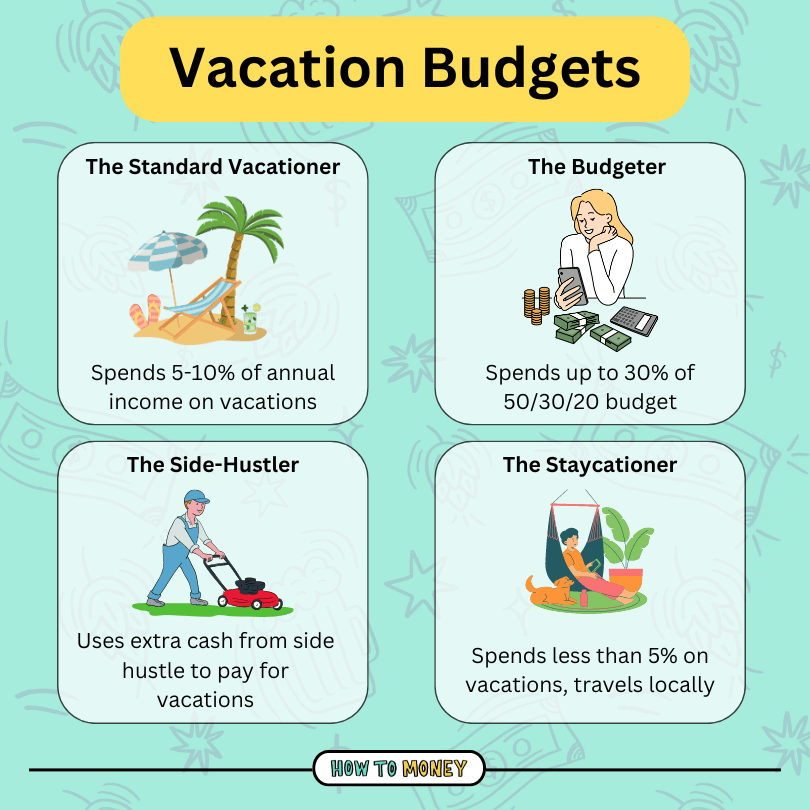
When it comes to figuring out how much you can afford to spend, it can be helpful to think of it in terms of your annual salary. For the standard vacationer, it’s generally acceptable to spend between 5-10% of your post-tax income on vacations.
However, if you want to spend a little bit more or less, you can! For example, if you’re following a 50/30/20 budget, you could, in theory, spend up to 30% of your pay on travel should you forgo all other discretionary spending. While we wouldn’t necessarily recommend that, as long as you’re managing your living expenses and saving and investing 20%, you’re free to adjust that amount in alignment with your values.
Step 2: Create a vacation budget
If you want to save up for your vacation, it’s crucial to figure out how much it will cost ahead of time! That means creating a vacation budget.
Estimate how much money your trip will cost in total. Remember that this includes more than just your lodging and transportation costs. Museum trips, snacks, rental cars, and even parking costs can quickly add up, becoming a major expense you didn’t anticipate, leaving you with a spending hangover.
Start by making an itinerary of all the activities you plan on doing. Then add up all the approximate costs to get your final number. If you want to maintain some flexibility during your trip, you can always round up your vacation budget by a few hundred dollars. And if you don’t end up spending that much, you can put whatever you don’t spend towards other savings goals – or your next trip!
Here’s a list of some expenses you may want to include in your vacation budget:
- Airline tickets
- Gas (If driving)
- Train/subway tickets
- Rental car
- Food/snacks/groceries
- Activity costs
- Entrance fees
- Tour costs (remember to ALWAYS bring cash to tip your tour guides)
- Checked bag fees (pro tip– many travel credit cards can often come with free checked bags!)
- International phone plan
Lastly, don’t forget to include those little purchases you always seem to convince yourself you need right before your trip…
- Travel-sized toiletries (consider buying reusable bottles to save!)
- Clothes
- Luggage
- Hair/Nail appointments
- Airport Food
Being specific with this budget is better because while you are traveling you’ll want to know how much you can spend on various activities. It’s easy to get lost in the romance of travel and accidentally overspend. So keep a digital copy of this budget with you to reference back to.
Step 3: Create a vacation sinking fund
A sinking fund is a great tool that you can use to save up for future vacations.
Sinking funds are essentially buckets of money that you save up to pay for irregular expenses. For example, you can create a sinking fund to save up for home/car maintenance, education expenses, replacing home appliances, and even holiday gifts! It’s the perfect way to save for expenses you know are coming up but that may not fit perfectly into your monthly budget.
To make this sinking fund, you’ll need to create a place to hold your money. How you store your sinking funds is up to you. You could keep it in your savings account and keep track of your savings within your monthly budget, or even go as far as to open a separate bank account for your vacation savings.
Pro tip: Using a budgeting app like YNAB can help segment your money into different digital buckets for various money goals!
Step 4: Figure out how much you need to save each month
Now, it’s time to make a game plan. The goal is to break down your overall trip cost into little savings goals you can sock away before your trip.
Luckily, you don’t need to be a numbers wiz to figure this out. The math is simple. Just divide your vacation budget by the number of months you have until the payment is due. For example, if you’re looking to take a trip a year from now, and your vacation budget is $4,800, you’ll need to sock away $400 each month.
If it’s easier, you can even break this down further to weekly savings. Doing so can keep you feeling motivated to make your trip happen. Small goals can help you move big mountains. It often feels easier to save $92 per week than to magically come up with $4,800.
Step 5: Create an automatic transfer
If you’re forgetful, like I am, automating your savings can make it easier to reach your goals. This goes for all aspects of personal finance, like saving for a down payment, retirement, or paying off debt. Saving for vacation is no different.
Automating your finances comes with myriad benefits. It can help to eliminate decision fatigue, save on fees and interest, and eliminate the temptation to spend your money before you save it. So, instead of trying to remember each month to contribute to your vacation fund, put it on autopilot, and create an automatic transfer to your savings.
Step 6: Go on your awesome trip!
Woohoo! It’s a few months later and your mindful spending habits and automatic transfers have carried you to success. Now it’s time to make memories, spend time with your loved ones, and drink rum out of a coconut.
Remember to fully disconnect from your work life, and be present during your trip. (And send me lots of pictures so that I can live vicariously through you! 😉)
10 Ways to Save More for Your Vacation
If your vacation budget is higher than your monthly savings will allow, don’t panic. You don’t need to save for 5+ years to your vacation dreams a reality. Instead, it’s time to roll up your sleeves and get a little creative. Lucky for you, we’ve compiled a list of our top 10 ways that you can save more for your vacation.
When it comes to affording your dream vacation, there are two approaches you can take; earning more and spending less. We’ll explore both options in the savings tips below. Combining a few of these tips is a surefire way to put your vacation within reach.
1. Use credit card rewards to travel for cheap
One of the best ways to reduce the cost of your vacation is to use credit card rewards to travel for free. Many credit card companies will offer you generous points or miles bonuses for opening a new card and meeting the minimum spend in addition to rewarding you for your everyday spending.
When redeemed for travel, these signup bonuses are anything but insignificant. For example, last year I opened up the Capital One Venture Card about six months before a trip to London I was planning. I earned the 75,000 bonus miles from my signup bonus, as well as 16,779 miles from my everyday spending. I was able to fly myself, my sister, and my dad from New York to London for just $805 total!
The following year, I combined a signup bonus from my Chase Sapphire Preferred and Venture X cards to save nearly $2,000 on a trip to Disney.
These rewards can be even more powerful when you get friends and family in on the fun. Most recently, my dad used his ~220,000 Capital One miles to fly himself, my two siblings, and me to Belgium for under $1,000 out of pocket.
Here are my top picks for best travel credit card offers right now!

Important note: Credit cards are only worth utilizing if you can follow the golden rules of plastic. This means paying statements off in full and on time every month and avoiding overspending. If you end up paying interest or spending more than you otherwise would have, it completely negates the rewards and can hurt your finances in the long term. Responsible credit card usage is a must if you want to start using travel rewards responsibly.
Even further, many of these cards have annual fees ranging from $95-695 per year, so do the math and make sure the reward value exceeds the cost.
2. Try a no-spend challenge
If you want to save up a lump sum for your vacation quickly, why not try a no-spend challenge?
A no-spend challenge may sound simple, but it can be more arduous than you might think! You can opt to either forgo all discretionary spending or to cut out spending in a different category each month. For example, you could do a no eating out challenge for one month, followed by a no-shopping month.
For example, my buddy Joel O’Leary recently planned a Valentine’s Day getaway for him and his wife. In order to save as much they could for their vacation, they decided to skip eating out for the two months leading up to their trip. They realized that every meal they didn’t eat out at home was a meal they could enjoy together in paradise! If your takeout spending has been a little too high for comfort lately, why not try cutting it cold turkey to save up more for vacation?
3. Pay off debt
If you’re struggling to set aside money for your vacation each month, it might be necessary to work on paying down your debt first. Doing so can help to lower your monthly debt obligation, or eliminate a monthly payment from your life altogether, making it easier to save!
If you have high-interest debt, like credit card debt, put together a debt payoff plan to eradicate it from your life. And if you have a lot of debt, it may be worth prioritizing it and pushing back your vacation plans until you can whittle it down. This temporary sacrifice could make it easier to enjoy regularly scheduled vacations moving forward.
4. Negotiate your bills
You may be shocked to find out that you have more power over the cost of your bills than you think. Nobody likes paying bills, and chances are you’re paying more than you need to.
Negotiating your bills means you can redirect those savings to your vacation fund! Set aside a few hours to call your internet provider, cable company, and insurance companies and ask if they have any new customer promotions you can take advantage of. If their hands really are tied, don’t be afraid to shop around for a better rate. Also, changing your phone plan to a more affordable MVNO, or switching your internet provider might seem like a huge hassle, but it really isn’t that bad. Trust me, the savings will be worth it.
Pro tip- Sometimes the first person who answers your call may not be best equipped to help you save. If you aren’t getting anywhere, try asking for the customer retention department. Their job is to try and convince you to stay with that company, and they can often have more power to offer you larger discounts and concessions.
5. Go where the deals are
When it comes to saving money on vacations, being flexible can result in mountains of savings.
If you don’t have your heart set on a destination, try going where the deals are! Airlines will often send out email blasts with vacation deals, and signing up for emails from Going means finding out about airfare sales in real time. Doing this can help to seriously reduce your vacation costs, and can even allow you to travel more often.
6. Make it a road trip
If you’re traveling with multiple people and are down with domestic discovery, why not make it a road trip?
Traveling by plane can be convenient, and can even be cheaper than driving if you’re alone. But when you’re able to split the cost between 3-4 people, driving can be more economical. For example, a round-trip flight from New York to Nashville can cost around $180 per person, making the total flight cost $720 for a group of 4. However, the cost of driving back and forth comes out to around just $240 total or just $60 per person! Plus, when you arrive, you won’t need to spend a dime on rideshares or rental cars.
7. Start a side hustle
A great way to save more cash quickly is to start earning money on the side. There are plenty of side hustles and gig economy jobs available these days. And most are available immediately and require no experience!
Bartending (or waiting tables) is probably the most old-school way to make money quickly. Think about this: Making just $100 per shift, and 4 x shifts per month is $400 you can sock away for your vacation fund. That’s a cool $5k a year you can save up!
Just be sure not to overdo it when working two jobs. You’re still a human who needs rest, relaxation, and time away from work.
Another way to get a pay bump without working more is to negotiate a raise!
8. Sell your stuff
While I will discourage you from selling your kidney on the black market to afford that spring break to Bali, I would encourage you to clean out that stuff from the back of your closet and sell whatever you no longer use!
Selling your stuff is the perfect way to save up some extra money for an upcoming trip. It requires a little bit of work on the front end, but you’ll be left with a tidier home, and a few extra dollars to throw at your vacation fund.
9. Make your own meals
When you travel, one of the biggest expenses can be meals out. While you should absolutely experience local cuisine when traveling, it isn’t necessary to eat out for every meal of the day.
It’s no secret that eating out is way more expensive than eating at home. Grabbing a few simple groceries to eat for breakfast and lunch while on vacation can save you hundreds of dollars. Between getting breakfast and lunch out, you could be looking at up to $40 depending on which restaurants you go to. Instead, stock up on easy-to-eat staples like yogurt, sandwich ingredients, and breakfast bars, and splurge on that nice dinner out every night.
10. Start planning early
The more time you have to save for a vacation, the less you’ll need to put away every month. With thoughtful planning, you’ll be able to save up gradually over time and can reduce strain on your budget. Plus, being proactive means having more time to shop around for hotels, flights, and activities, often resulting in lower prices!
The Bottom Line:
When you save upfront for your vacation, you’ll derive more joy from your trip, largely because you’ll avoid money worries and debt-related stress. You’ll also stretch your vacation budget further because smart planning means buying things at a discount and not paying any interest!
With a little creativity and discipline, you’ll be able to save up over time for the vacation of your dreams. Just make a travel budget, break it down into monthly savings goals, and put all the money in an account you won’t touch. A little planning upfront can save huge headaches down the road. Safe travels!
Related Posts:
- How to Take a Year Off Work!
- Best Hotel Credit Cards for Frequent Travelers in 2024
- Saving Money on Travel: A HUGE list of tips and tricks…
*Advertiser Disclosure: How to Money has partnered with CardRatings for our coverage of credit card products. How to Money and CardRatings may receive a commission from card issuers. Some or all of the card offers that appear on the website are from advertisers. Compensation may impact on how and where card products appear on the site. Lastly, the site does not include all card companies or all available card offers.
*Editorial Disclosure: Opinions, reviews, analyses & recommendations are the author’s alone, and have not been reviewed, endorsed or approved by any of these entities.
*User Generated Content Disclosure: Responses are not provided or commissioned by the bank advertiser. Responses have not been reviewed, approved or otherwise endorsed by the bank advertiser. It is not the bank advertiser’s responsibility to ensure all posts and/or questions are answered.