

If you want to climb a mountain, it’s going to be much more difficult if you have bricks in your backpack. Likewise, reaching financial independence is a hundred times harder if you’re holding onto high-interest debt.
Being in debt while trying to build wealth is like running up a down escalator. For every 3 steps you take forward, your debt pulls you back 2 steps. It’s exhausting!
That’s why early on in your journey you need to slash all bad debt out of your life. The sooner you do, the quicker you can move through all the other money gears to achieve your goals.
We created the money gears to create a roadmap to financial success that anyone can follow. By shifting into each of these gears in order, you can achieve your financial dreams in the most efficient way possible.
BTW- If you haven’t already tackled money gear 1 and money gear 2, it’s important to cycle through those steps first!
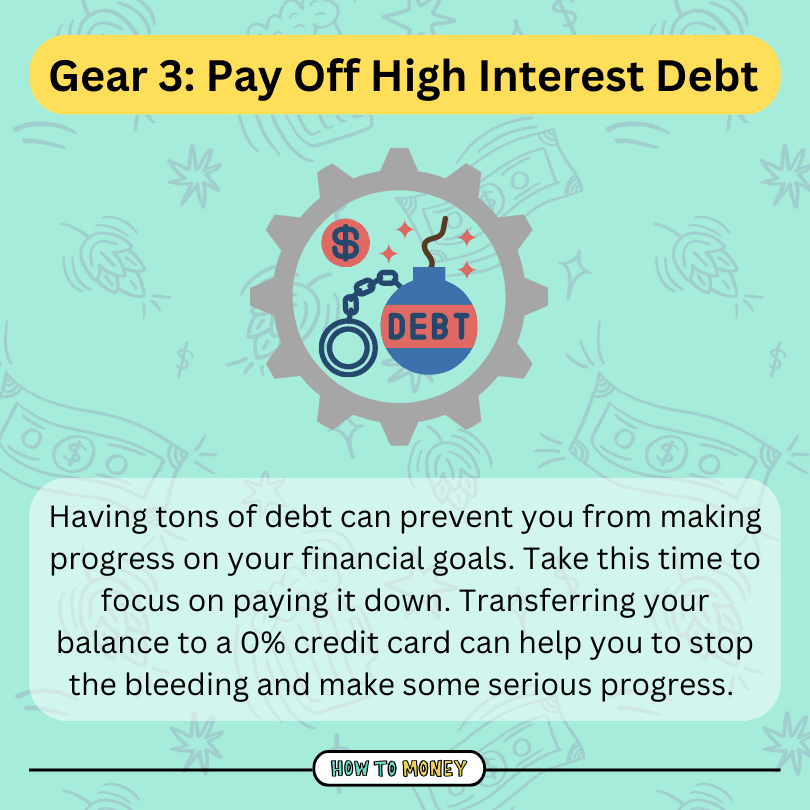
First, let’s look at what “high interest debt” actually means. Then we’ll talk about strategies to pay it off and which debts should be prioritized.
Good Debt Vs. Bad Debt
Simply put, bad debt is anything with a high interest rate. Think: any loans higher than around 7% (except for your mortgage). Or any loans that were taken out to buy depreciating assets, like a car or a personal loan.
You probably know already – credit card debt is the worst of all. Interest rates can be as high as 35%!
Even worse, compound interest causes that debt to grow continually, every day. Instead of interest being calculated only based on the money you borrowed, it’s calculated on your entire outstanding balance.
Basically, your interest earns interest! A real bummer for anyone with credit card debt.
Good debt, on the other hand, carries relatively low interest rates. Think, anything less than ~7%. While you definitely want to tackle good debt eventually, it’s not as high a priority as that blood-sucking high-interest debt.
At the end of the day, bad debt makes everything you buy more expensive. If you only make minimum payments, you’re likely on a treadmill that is preventing you from building wealth.
How to Pay Off High Interest Rate Debt
I’m not going to beat around the bush… Getting out of high-interest-rate debt is hard work.
But, it is possible. And it is WORTH IT!
You just need a solid plan and dedication to becoming debt-free. Here’s a step-by-step guide:

Step 1: List out all of your debts
You must face the numbers head-on. Don’t run, hide, or shy away from these ugly debts.
The first step is to tally up all the debt you have. While this can be scary for some folks, it is also freeing. Confronting your debt head-on is the first step toward getting out of it.
Maybe the total amount is more than you thought, or maybe it’s a bit less and you’re relieved. Either way, today is the first day of your debt payoff journey, and that’s a magical thing.
So, look through all of your credit card and loan statements, and list out all of your debts, the amount, and the interest rate. This will help you to get organized and come up with a plan for tackling these debts in the best way possible for you.
Here’s an example of what this list could look like:
| Debt type | Amount | Interest rate |
| Amex Credit Card | $545 | 22% |
| Chase Credit Card | $3,200 | 19% |
| Car loan | $6,500 | 9% |
Now that you’re looking at all your debts in one place, we can develop an attack plan…
Consider negotiating for a lower interest rate
One thing that could make it easier right off the bat is trying to negotiate a lower interest rate. Any money you save on interest will immediately give you more cash to put into paying off principal!
Try calling your credit card companies or loan providers to ask if they are able to lower your interest rate. While they might not be able to help you, this simple phone call takes about 5 minutes and is always worth trying! It can save you hundreds if not thousands of dollars over the course of your debt repayment journey.
Step 2: Choose a repayment method
Next, it’s time to figure out how you want to go about paying off this debt. We recommend using one of two repayment strategies, the debt snowball, and the debt avalanche. Which one will be the best for you depends heavily on your personality.
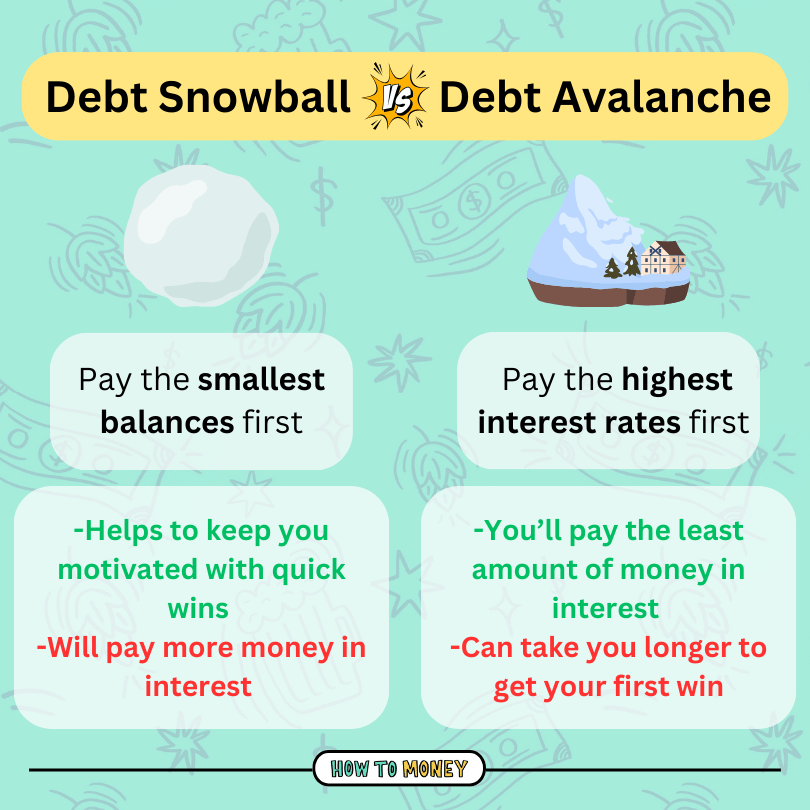
The debt snowball method:
The debt snowball method is best for folks who are motivated by small wins. This will help you get some debts off your plate the most quickly, generating some positive momentum to help carry you through.
This method focuses on repaying the debts with the smallest balance first. Then, you snowball that debt payment into the next. Here’s how it works.
You start by making the minimum payment on all of your debts. Any extra debt repayment money will be put towards the debt with the smallest balance. Then, once it’s paid off, you’ll roll that payment money, plus your extra debt repayment money into the next debt with the lowest balance.
Here’s an example:
Samantha has $400 to put towards debt repayment every month. Her debts look like this:
- Credit card 1 (18% interest rate): $500 balance with a minimum payment of $25 per month
- Credit card 2 (20% interest rate): $1,250 balance with a minimum payment of $20 per month
- Credit card 3 (22% interest rate): $2,400 balance with a minimum payment of $30 per month.
Samantha will pay the $20 and $30 minimums for credit cards 2 and 3, and $350 towards credit card 1 until credit card 1 is fully paid off.
Shifting her focus to credit card 2, she now snowballs her credit card 1 payment into credit card 2, paying $370 towards card 2 and the $30 minimum for credit card 3.
Then, when she pays off credit card 2, Samatha will put all $400 towards credit card 3.
The Debt Avalanche Method:
This payoff method is best for total, number-obsessed money nerds. It’s the fastest way to get out of debt and the most financially streamlined.
This method focuses on paying down the debts with the highest interest rate first.
Using this method, you’ll pay the minimums on all of your debts, and then whatever money is left over will go towards the debt with the highest interest rate. Once that debt is paid off, your former payment amount will roll into the debt with the next highest interest rate.
If Samantha decided to use this repayment method, her repayment would look like this:
Samantha pays the $25 and $20 minimums on cards 1 and 2, and will put the remaining $355 towards credit card 3, as it carries the highest interest rate. Once credit card 3 is completely paid off, she’ll keep paying the $25 minimum on card 1, and put $375 towards card 2. Lastly, once credit card 2 is paid off, Samatha will put all of her $400 monthly debt payment towards credit card 1.
Which should you choose?
The best debt payment plan is the one that you stick with. So either will work if you choose one and commit!
The debt avalanche saves you the most money. But the snowball route offers quicker wins, which helps with motivation. There’s no shame in choosing either route!
Oh, you can also mix these methods together. Feel free to come up with a hybrid if you’re so inclined – whatever works best for you!
Step 3: Make a debt payoff plan
Now, it’s time to put pencil to paper (or fingers to keyboard) and come up with an actual debt payoff plan.
By now you’ve listed your debts already and have chosen a payoff strategy. The next step is to look at your budget and figure out how much cash you can funnel toward debt repayment each and every month.
If you need to free up some money to make this happen, I would consider starting by negotiating some of your bills like insurance, cable, and internet, and canceling any subscriptions you aren’t getting enough value from.
Once you know how much money you have available to attack that debt, do your best to come up with a timeline for your debt repayment. Set some SMART goals for when you’ll have each debt paid off, and celebrate on the cheap once you reach them.
Step 4: Automate your repayments
Sometimes, our human brains just aren’t as reliable as we wish they would be. Like, sometimes you randomly don’t remember how to parallel park even though you’ve done it a million times.
And sometimes you forget to take the meat out of the freezer to defrost while your mom is at work and you only recall this as you hear her pulling into the driveway (I still have nightmares about this). And worst of all, sometimes you forget to pay your credit card bill…
One thing I’ve noticed about highly successful people is that they often put systems in place to work around the annoying reality of human nature. One day, we’ll all be part AI and our neuralinks will remind us to make our debt payments, but until that day automation can help us to stay on top of our finances and achieve our money goals more quickly.
If you want to pay off high-interest-rate debt and reach money goal 3 more quickly, setting up automatic payments to your credit cards can be a big help.
In fact, you should probably always have some form of automatic credit card payment set up to ensure you never miss a payment and hurt your credit score!
Setting up auto-pay will help you stay on track with your debt repayment plan without even thinking about it!
Step 5: Accelerate your progress
Once you’ve started paying off your high-interest-rate debt, you’re well on your way to reaching crushing this money gear.
But that doesn’t mean that you should turn a blind eye to potential ways to accelerate your progress!
Along the way, keep your eyes peeled for opportunities to save more money so that you can get out of debt even quicker. Here are a few ways that you can scrimp and save even more to prioritize your debt payments. The sooner those bills are eradicated the more quickly you can move on to bigger and better goals.
Slash your grocery bill
Groceries are one of our biggest monthly expenses, with the average American spending $832 on food every month. However, it doesn’t need to be this way!
While grocery prices have increased significantly in the past few years, there are still ways to fight back and slash your grocery bill. Often, switching where you shop to a budget grocer like Trader Joe’s or Aldi can provide you with immediate savings without even changing your shopping habits, to the tune of 33%.
Switch your phone plan
Whether you’re glued to your phone watching TikTok or trying to avoid spending any time at all on the phone, having a cell phone is a necessity in today’s society. But, that doesn’t mean you should pay through the nose for your cell service and data package.
These 5 cheap MVNOs work off of the same networks as the big three cell service providers (Verizon, AT&T, and T-Mobile), but come with major savings. For example, switching from Verizon’s unlimited plus plan to Mint Mobile’s unlimited plan can save you $25 per month!
Ask for a Raise
While saving money is certainly one side of the coin, earning more can also help you to pay off debt more quickly. One of the quickest ways to earn more money is to ask for a raise.
If you’ve been working for your employer for a few years and haven’t received a compensation boost, now’s the time to ask for one! But make sure to prepare for this conversation by researching average compensation in your field, increasing your skill set, and practicing your negotiation skills with a friend.
Start a Side Hustle
In addition to working to increase your compensation at your current job, you can also earn more money on the side by attempting a side hustle! A side hustle is work that you perform outside of your main job, and launching a solid side hustle can positively impact your finances for years to come.
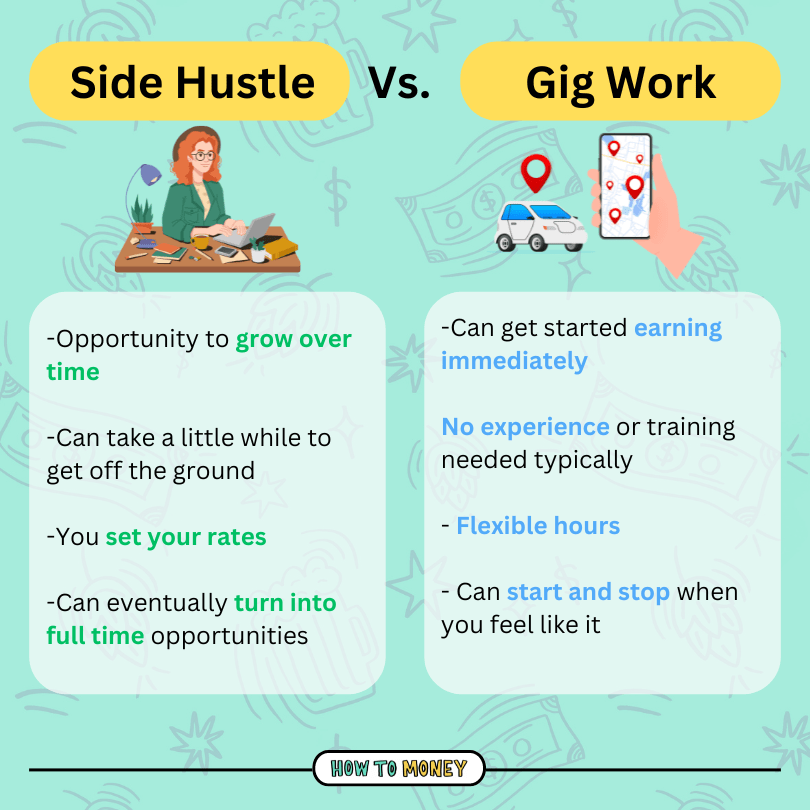
Remember, side hustles are typically superior to gig work. Gig work is all about trading time for money, while a true side hustle has the potential to grow into even more future earnings. Bonus points if you pick a side hustle that you genuinely enjoy- it’ll give you the opportunity to explore your interests outside of your 9-5
Step 6: Track Your Progress
When paying off high-interest-rate debt, it’s best to not adopt a “set it and forget it” mindset. Instead, make sure to track your progress along the way. Doing so can increase your motivation to actually carry through and see your goal out to the end.
As silly as it may sound, making a poster where you can color in your progress is extremely satisfying and I highly recommend it. Put it somewhere you’ll see it every day. Remember to take some time to celebrate every debt you pay off along the way too.
Have an at-home spa night, or treat yourself to your favorite takeout and a movie! When you finally reach that end goal of achieving money goal 3, you can take it a step further and celebrate with friends, family, or your significant other!
Step 7: STAY out of debt
The most important step in paying off all high-interest rate debt and achieving money gear 3 is staying out of debt afterward.
While it’s possible to end up falling back down to lower money gears, this is one we want to avoid most due to the sky-high costs of high-interest-rate debt. So, here are a few tips for avoiding high-interest-rate debt as you move on to money gears 4 and beyond.
Use your emergency fund
When emergency expenses pop up, refrain from using credit card loans or personal loans to cover them if at all possible. Instead, use the basic emergency fund you created in money gear 1 to take care of those expenses. Remember, that’s what it’s there for!
Once you’ve used any money from your e-fund, take a brief detour back to money gear 1 to replenish those funds.
Practice mindful spending
If you often fall victim to impulse buying, you need to spend some time working on building mindful spending habits. Mindful spending is the practice of being intentional with the ways you spend your money. It helps you to ensure that the ways in which you spend align with your goals and values, often resulting in major savings along the way!
Here are a few mindful spending practices to consider implementing into your daily routine.
- Identify and work around your spending triggers: If you tend to overspend on takeout when you’re tired after work, try stocking your fridge with readymade meals from the grocery store.
- Track your spending: You may be surprised when you see where all of your money is actually going…
- Ignore sales unless you truly need something: The best sale is 100% off.
- Think in terms of hours worked: You may not want that cool new jacket anymore when you realize that it’ll cost you 10 hours of your life!
- Use a 24-hour wishlist: Add items to your cart but don’t check out for 24 hours. You’ll be amazed at how often you forget about that purchase or no longer want those items.
Freeze your credit cards
If at the end of the day you still can’t curb your overspending tendencies, it may be a good idea to freeze your credit cards. I’m talking about literally freezing them in a bag of water.
In addition to this just being kind of silly and fun, freezing your credit cards will prevent you from taking them out with you and using them. When you’ve gotten your spending under control, you can try defrosting them and incorporating them back into your life.
The Bottom Line:
Reaching money gear 3 and fully crushing high-interest debt is a huge accomplishment. Now you can cycle even faster through your money journey unburdened by past purchases!
Remember that debt can creep back into your life if you’re not paying attention. So always follow the golden rules of credit cards, and be mindful of your spending habits.
Related Posts: