

Maybe you no longer need hand holding when it comes to your finances. Or maybe you’re sick of fees eating up your investment returns. Whatever the case, you’ve decided that it’s time to break up with your financial advisor. And we’re here to support and encourage you!
While in some circumstances financial advisors can be worth the money, oftentimes they can become dead weight to people who are fully capable of managing their finances on their own. The truth is, most people don’t need financial advisors, especially not for investing. Here’s how to ditch your financial advisor and take control of your finances like the smart and independent person you are! 💪
Reasons why you probably don’t need a financial advisor
Sit down and ask yourself, “What has my financial advisor really ever done for me that I couldn’t do for myself?”
Sometimes, advisors are sort of like your deadbeat college boyfriend Kevin who made you think you couldn’t live without him, when in reality being alone would have let you thrive!
I’m not trying to hate on financial advisors. There is definitely a place for their services. But if your assets are on the smaller side, or if you’re fairly young and have a long time horizon, the value of the work they do for you likely won’t be worth the fees they cost.
Here are just a few reasons why you should break up with your financial advisor.

1. Investing isn’t really that difficult
A lot of folks in the financial advisory world make investing out to be this complex world of graphs and numbers. They use acronyms, fancy words, and pull figures from Wall Street reports to make investing sound like an arduous slog.
But we’re here to tell you the truth: Investing does not need to be difficult! Trust me. If I can figure it out, you can too.
In fact, a simple investing strategy is usually the most effective. Begin with easy stuff like tax advantaged accounts. If you have a work sponsored 401k plan, this is a no brainer place to start, especially if you have an employer match. If not, open a Roth IRA or Traditional IRA. Then, purchase low cost, highly diversified index funds, like the S&5P 500.
Let go of the concept of needing to constantly manage and trade your stocks. Buying and holding your stocks for the long term is a great way to reduce your chances of losing money.

You, yes YOU, can master the basics of investing with a few short hours of research. If you’re not sure how to get started, try checking out “How to Invest: A Beginner’s Guide.”
2. Index Funds BEAT Managed Funds
If you needed even more convincing to break up with your financial advisor, you’ll love this little fact: Most managed funds don’t even beat the overall market return. In fact, over the course of twenty years, 94.8% of managed funds fell behind the S&P 500.
Plus, the New York Times studied 2,132 actively managed funds, and not one of them were able to beat their target benchmarks. Remember, these are people whose entire job is trading stocks. This is why you’re probably better off just investing in index funds on your own.
Paying a financial advisor a fee, only to give you sub-par performance, is like paying a gourmet chef to serve you burnt toast and instant ramen. You can cook better meals at home, fee free!
3. Most advice and info is available online (for free!)
While financial advisors can help you to think through important aspects of your finances like insurance, budgeting, or big picture goals, often you can get the same information online without forking over a cent.
There are tons of free resources available. Books, podcasts, free courses, and even forums – like our HTM Facebook Group!
The biggest financial decisions typically just require personal focus and time to reflect. Oftentimes, financial advisors tell you things you already know, you just wanted to hear it from someone else. This is why we recommend everyone spend some time reflecting on your values to understand the “why” behind your money.
4. Financial advisors can be expensive
Another huge reason to break up with your financial advisor is because they are too expensive. Like, REALLY expensive.
Many financial advisors can charge as much as 1% of your assets each and every year. And while this may not sound like much, these fees can seriously add up when it comes to growing wealth for the long run.
For example, if your financial advisor is managing $100,000 for you, and charges 1%, you’ll pay $1,000 each year. You might not think that’s significant, but as your investments continue to grow, so will the fees you’ll pay out. If your retirement nest egg reaches $2,000,000, you’ll find yourself paying $20,000 per year to your financial advisor. That’s not chump change!
Probably the worst part is how much fees rob your potential investment growth over the years. Each year you pay an advisor fee, you’re forfeiting growth on that money. Here’s an example of how much is deducted from your nest egg with a 1% fee

Even if advisors could provide identical investment returns (we’ve established they can’t), their fees over time add up in a massive way! The example above shows that a 1% advisor fee costs a total of $226,000 over 30 years!
I don’t know about you, but I would rather have that extra $226k in my pocket in retirement!
5. Sometimes they sell you stuff you don’t need.
Many financial advisors earn commissions by selling you certain financial products. When they do this, you run the risk that they are acting in their own best financial interest, not yours.
That’s why if you need a financial advisor, it’s important to choose one who is a financial “fiduciary.” These types of professionals are legally obligated to act in your best interest. If you are unsure if your current advisor is a fiduciary, ask them to provide you with written proof of their fiduciary status.
If a financial advisor is pushing you to sign up for universal life insurance, it’s time to break up with them immediately!
6. There are free/cheaper financial advice alternatives
In some situations, you may want guidance from professionals. And if that’s the case, you can usually find cheaper, and sometimes even free alternatives to hiring a financial advisor.
For example, if you’re struggling with managing debt, try instead reaching out to the NFCC. They’re a non profit that provides low cost debt management counseling. You could also check out Money Management International for low cost counseling on topics like student loans, bankruptcy, debt management and home buying.
Another option is paying an advisor on an hourly basis. Even if you fork out $100 for 10 hours, you’re only out $1,000, not an ongoing fee you are stuck with each year. Nectarine is a great platform that helps connect people with advice-only financial advisors across the country. You pay a flat hourly rate for advice only, no management or ongoing fees!
The Few Exceptions
In some situations, you really may need the help of a financial advisor. In life changing financial events, like divorce or inheriting money from a family member, getting some professional guidance may prove to be extremely helpful. Or, if you’ve got a Jeff Bezos sized fortune, first of all- congrats (and please read this article about how giving away some of your money enriches your life), and secondly, it might be worth it to have someone help you manage overly complicated finances.
We’re not saying everyone needs to break up with their financial advisor. Just know that most people can do without!
How to Break Up With Your Financial Advisor
Look, breakups are never easy! But at least this one probably won’t result in you laying in bed for days shoveling down pints of Ben and Jerry’s salted caramel core ice cream.
It’s not nearly as difficult to break up with your financial advisor. Actually, they are used to it and it happens regularly for them. Any awkwardness is mostly in your own head!
Here are the steps you should take to ditch your financial advisor and become fully self-sufficient.
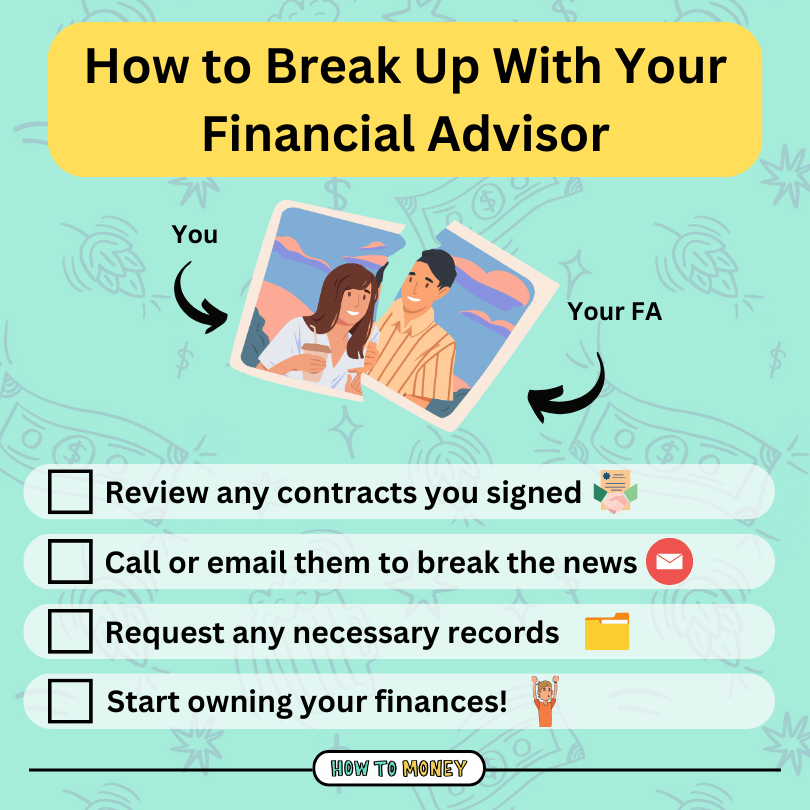
1. Review any Contracts
The first step is to figure out what contractual obligations you have with your financial advisor or the firm they work for. If you don’t have the contracts on hand, reach out to them and ask for a copy. (Yes, this might alert them to the fact you’re about to dump them, but that’s ok! In fact, it gives them a slower let down and makes it easier when you drop the news)
In addition to reviewing the contracts, you’ll want to make sure you understand the procedure for terminating their services. Some advisors may require a certain amount of notice, or may impose fees for not continuing.
Knowing the process and any fees upfront is necessary to prevent surprises and keep the relationship on good terms.
2. Call or Email Them to Break the News
Now comes the hard part. It’s time to search for the right words to break up with your financial advisor once and for all. If you’re concerned about hurting their feelings, don’t be. It truly isn’t anything personal, and they likely won’t be heartbroken. They’re probably seeing tons of other “clients,” just like Kevin. You do not need to feel guilty.
Give them a call, or send them an email letting them know that you’ll no longer need their services. Be polite, but firm. Think, “it’s not you, it’s me! I’m ready to grow as a person and explore new things.”
Still nervous about breaking the news? Here are a few things you can say (or not say) during your break up call.
| Instead of saying… | Try this… |
| “Your 1% fees are just not worth the services you provide me” | “My financial priorities have changed, and I’m looking to go the DIY route.” |
| “You don’t really do anything that I couldn’t do myself.” | “I’ve learned a lot about personal finance over the past few years, and I am ready to take on managing my own finances.” |
| “My friend told me that financial advisors can’t beat the market!” | “I’ve given it a lot of thought, and I would like to pursue a simpler investing strategy with low cost index funds, which I can manage on my own.” |
| “My investments aren’t performing well like you promised” | “Thank you for the years of help and service you provided. I’m confident in managing and growing my families wealth going forward” |
As you can see, staying positive and using definitive language works best. Don’t dwell on the past or any negatives. Look to the future and continue to express confidence that you can manage things yourself.
Handling objections
It’s natural for advisors to try and talk you out of leaving. So don’t be surprised if they ask additional questions, or state things you may not have thought of.
Here are a few ways you might be able to handle their objections to you breaking up with them:
| Their Objection… | Your Response… |
| “Is there anything you’re unhappy with or something I did wrong?” | “Nope, I’m super thankful for your services over the years. I’ve just decided to self manage from here on so I won’t be needing your help anymore” |
| “If you leave now, you run the risk of [insert fear tactic]” | “Thanks for letting me know. I’ve studied a lot about this particular topic, and I’m confident in solving that problem myself” |
| “The market is about to go [up or down] and our experts really recommend xyz. You don’t want to miss out” | “I realize there will be volatility and market swings, but I’m much more concerned with long term growth over the next few decades. Thank you, but I can navigate this myself” |
| “We build tailored solutions to meet your individual situation and needs, so you don’t have to worry or stress” | “I’m growing more confident every day and have decided to take control of my own finances. Thank you again for everything you’ve provided over the years” |
| “Well how are you going to handle [insert confusing investment jargon]?” | “Great point, that’s something I’ll need to look into more and figure out as part of my DIY plans going forward” |
| “What if we reduced our fee, or gave you free tickets to a wealth seminar?” | “I appreciate your offer, but I’ve given this a lot of thought and I have made up my mind.” |
Keep your responses short, and stay confident! You got this.
Draft Letter to Break Up with Your Financial Advisor:
If you’re planning on sending an email, feel free to use the below break up template:
Dear [Advisor],
I hope this email finds you well.
I am writing to you today because I have decided to discontinue the financial advisory services I receive from your firm. Going forward, I plan to manage my assets personally.
I’m really grateful for all of the guidance you’ve provided over the past few years, and thank you for respecting and understanding my decision to part ways. To facilitate this transition, I would like to request you provide instructions for next steps, and send over any necessary paperwork or documentation to close my account with you. Please also cease any ongoing trading or activity with my account.
Please let me know if there is anything else required on my end. And thank you again for your help.
Sincerely,
[Your Name]
Or, you could always just ask Chat GPT to write it! 🤷♀️
3. Request any Records
The next step after you officially break up with your financial advisor is to request any records you might need after you leave. You’ll want to keep anything going forward that will help you.
At a minimum, you’ll need to request important tax documents. It’s also important to ask for account statements, presentations you liked or any customization they detailed for you. Remember that your financial advisor is still here to help, so it’s OK to ask for all this stuff.
If you have the ability to log into to their systems, there’s a good chance you can gather docs yourself. Also, if you are already with a large brokerage firm (like Fidelity, Schwab, etc) you might not even need to change logins. Your accounts don’t have to move brokerage firms to remove advisory services.
Changing brokerage firms
In some cases, breaking up with your financial advisor will mean you need to migrate your portfolio over to a new brokerage firm.
To begin the process, first open up a new account with the broker you want to use going forward. We recommend Fidelity, Schwab, or Vanguard if you’re going to self-manage your investments. They are the biggest brokers in the world, and offer free accounts as well as a wide range of low cost index fund options!
Next, the new broker will typically follow an “ACAT” process, which stands for Automated Customer Account Transfer. You will help initiate this by sending your new broker your latest account statement and telling them exactly which assets you want to move over.
Transferring assets “in-kind” means that the new broker will assume all the same investment positions you currently own. Any stocks/bonds/funds that your old broker managed, would move over to the new broker for you to manage. This is the best process, because it avoids taxable events of buying and selling funds.
In rare cases, the new broker might not be able to assume some account positions. In this case, they might make you liquidate (sell funds) and then transfer your assets over as cash. If this is the case, we strongly recommend calling the customer service number of your new brokerage so they can hand-hold you through that process.
4. Start Your Self Management!
Now, it’s time to pull off a major financial glow up that’s going to make Kevin- uh I mean your financial advisor wish they had done more for you.
Here are a few first steps you should take to start managing your own money.
Change Investments (if needed)
Chances are your financial advisor put you into some investment funds that you might want to re-think. Old-school, actively managed mutual funds have extremely high expense ratios. So it’s best to double-check all the funds your money is invested in to make sure they are still a good fit for you long term.
**Important note** Selling funds or stocks that have grown in value will trigger capital gains tax if not inside a tax-deferred retirement account. It’s really important to consider tax consequences BEFORE selling any funds. If you have a huge amount of gains, it might make sense to migrate funds over several years.
Index & Chill Investments
We recommend adopting a super chill and basic investment strategy. This is going to be just as effective, if not more effective than whatever your financial advisor was doing with your money.
All you’re going to do is invest in low cost, highly diversified index funds. For folks who are getting closer to retirement, a target date fund might make a little more sense. Even when the market dips, continue to buy and hold these funds. If you invest for the long term, you can expect an average return of around 8-9% each year – no fancy day trading or single stock investing necessary.
I stress average because no year in the stock market is actually average. There’s a ton of volatility each year that you’ll have to endure. Big swings upwards, and some big downturns. But, the longer you stay invested, not touching any funds, the more likely you will achieve overall 8-9% average returns.
Index investing is a much more reliable investment strategy than single stock investing. Most stock pickers underperform the S&P 500, and you run the risk of losing large amounts of money if that company suffers. If you own index funds instead, sure, you’ll own some companies that are going to underperform. But you’ll also own winners too!
Utilize tax-advantaged accounts
As you invest more money over time, have a think about which accounts you should contribute to that will give you the most long term value.
If you have access to a workplace 401k plan, investing there will lower your taxable income for the years in which you contribute. This is an account most folks should prioritize for retirement savings!
Roth IRA’s are amazing investment vehicles too. Money that goes into a Roth IRA grows tax-free, forever. You can also withdraw your original contributions at any time.
Everyone’s situation is different, so it’s best to research the tax-advantaged accounts that make most sense to you. Prioritizing these will make your investments grow faster over time!
Emergency Fund Check
First, check in with your savings and cash position. Do you have enough cash on hand to cover an emergency should one pop up?
While some irregular expenses can be planned for using sinking funds, like car and home maintenance, or holiday gifts, certain expenses just can’t be planned for. This is where your emergency fund comes in.
Ideally, you’ll want to make sure you have 3-6 months worth of expenses saved up, but a great place to start is by creating a basic emergency fund of $2,467, which should help you to cover most basic emergencies.
Budget check
If you don’t already have a budget, it’s time to make one.
While budgets get a bad rap for being “restrictive” or “time consuming,” we believe the opposite is true. Budgets can give you the freedom to spend on what’s important to you, provide you with peace of mind, and can realistically be managed within about 1-2 hours each month. Plus, once you realize that you can allocate that money anyway you choose, the real fun begins.
Even then, if you still don’t want to take the time each month to create your budget, consider using software like YNAB. This all-in-one budgeting app links to your bank account and categorizes your spending for you. While it does cost a small amount of money, most of their users save $6,000 in their first year of using it!
Create a Debt Payoff Plan
Some financial advisors can also help you with debt counseling, and can create a debt payoff plan for you. However, this is also something you can create for yourself in most cases.
Simply add up all of your debt, and choose your pay off approach. Two common methods of paying off debt are the Debt Snowball and Debt Avalanche.
Using the debt snowball method: You’ll focus on making the minimum payments on all your debts, and throw any additional money towards your smallest size debt. Once you pay that off fully, you roll those extra payments over towards the next smallest debt, and so on. Think of it like rolling a snowball down a hill. It grows and picks up steam the further it goes!
The debt avalanche method is the opposite. You still make minimum payments on all your loans, but any excess savings is all put towards the debt with the highest interest rate. Then, once that’s paid off, turn your attention to the next highest interest rate, and so on.
While the debt avalanche will save you the most money over time, the debt snowball can provide you with much needed motivation to keep going!
When in doubt, look to the money gears
And if you find yourself panicking because you don’t know what your next move should be, you can always look to the “money gears” for help!
It can be difficult to know which aspects of your finances you should prioritize first. Luckily, we created the seven money gears as an order of operations that can help most people tackle important financial “to dos” in an order that will allow them to build wealth and enjoy financial stability!
Continue to Learn and Grow
Lastly, remember that although the basics are easy to master, there is always more to learn when it comes to personal finance. Continue to educate yourself in the sphere of personal finance through free resources like podcasts, books, and online courses. Staying up to date on your personal finance knowledge can help you to continue to make educated decisions for your money and your overall future.
The Bottom Line:
Unless they are providing you measurable, stellar value, it’s time to break up with your financial advisor and start self-managing your finances. Don’t worry, the break up process will be quick and professional, just remember to stay positive and confident.
With a simple index investing strategy, you can not only save on financial advisor fees, but you’ll likely outperform managed funds. Although investing yourself may feel intimidating, managing your own wealth building is way less complicated than you think. You got this! 💪
Related Posts:


Really helpful article, Britney. Wlhile most of the article is about wealth-building, I’m almost 75 years old. I just want to hang on to the money I have! My broker charges 1%. My money hasn’t done all that well and it hurts to see that 1% deducted from the bottom line.
I think I would like to just go to Vanguard, Schwab or Fidelity. But I don’t want to be a fool. This is all the money I have. What do you think?
Thank you for your excellent blog! I’ve been considering switching my financial advisor, and your advice is just what I needed. I am hoping to make better educated financial decisions in the future. Please continue to share your expertise!