
Cars cost WAY more than most people realize. I’m not talking about the initial sticker price. It’s everything associated with cars over time… Ongoing maintenance, the odd repair bill, financing and loan payments, insurance, depreciation, etc. Owning a car is expensive.
But here’s the thing – if you make a few smart moves, you can save a ton of cash and lessen that burden, gaining financial flexibility in the process.
Below we’re going to cover the do’s and don’ts of car ownership, from a financially savvy perspective. While you might not be able to follow every rule to a T, the more of these guidelines you can stick to, the more money you’ll save.
And with that extra cash, you’ll be in a better position to invest in things that grow your wealth, rather than watching it drain away into a car that’s losing value. Let’s get to it 👇👇👇
Buy Reliable, Not Luxury 🚗
We all want a fancy car. Heated leather seats, a slick badge on the hood, that new car smell.
But do we need it? Nope.
A car’s job is simple – to get you from point A to point B, safely and reliably. Everything beyond that is just extra money out of your pocket.
Here’s the double-whammy of luxury cars… They’re not just expensive to buy, they’re expensive to own.
Consumer Reports consistently finds that high-end brands like BMW, Mercedes, and Land Rover rank lower in reliability than good ol’ Toyota, Mazda, and Honda. Fancy cars come with fancy problems – electrical gremlins, overpriced parts, and complicated systems that only the dealership can fix (for a very steep price).
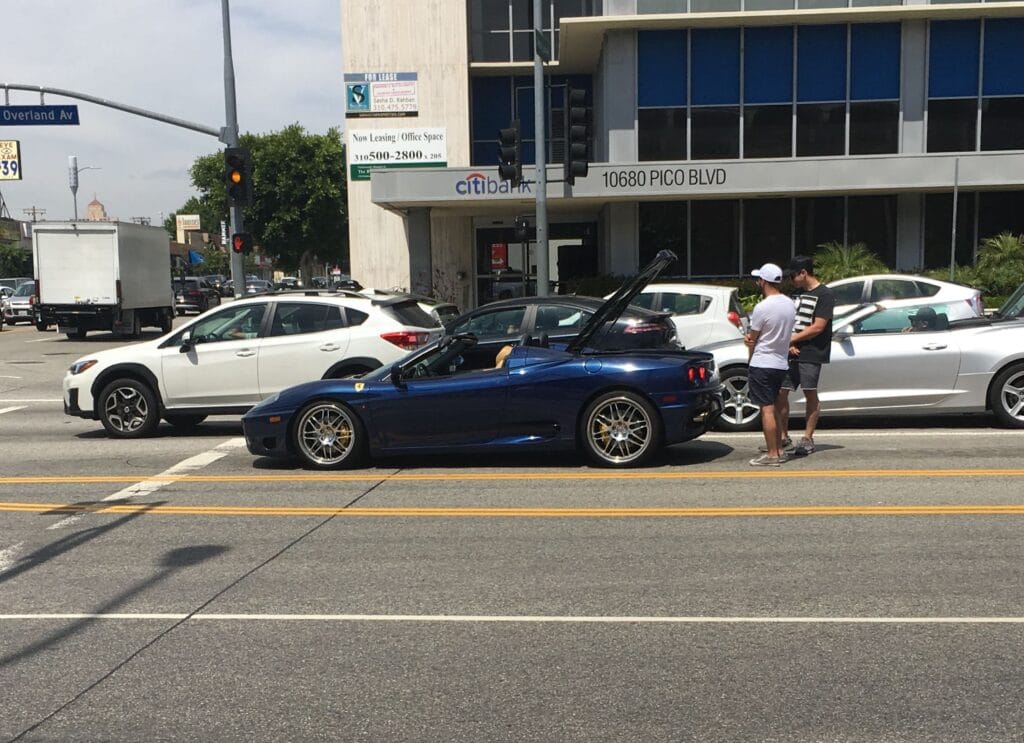
Funny story – the pic above is of a Ferrari I saw broken down a couple years ago in the middle of a busy street. I’ll never forget the face of this stressed-out owner, waiting for the tow truck.
Fancy cars break down just as much as regular cars, if not more.
Let’s talk about maintenance. Need an oil change on a Toyota Prius? That might set you back $50. Personally I just bought a 3-pack of oil changes for $129 at my local Toyota dealership. Woot woot! The same basic service on a BMW? Could be $300 or more.
Brake replacements? A luxury car could cost double or triple what you’d pay for a non-luxury brand. And when something big breaks (because it will), that repair bill might make you wish you had never bought the car in the first place.
Meanwhile, a reliable car just… works. No drama. No massive repair bills. No stress. And that means more money left over for things that truly make your life better. More travel with the family, growing your investments, or just not worrying about car payments. 😌
So yeah, a luxury car sounds nice. But you know what’s even nicer? Keeping your money.
Pay in Cash if Possible 💰🚗
Car dealers love financing. Why? Because it makes them BIG bucks. Sometimes they make more profit from financing the vehicle than from the markup of selling you the car!
When you finance a car, you’re not just paying for the car – you’re paying interest, fees, and whatever sneaky add-ons the dealer talked you into. Meanwhile, they’re high-fiving in the back office because they just locked you into years of payments with steep interest attached.
But paying in cash? That’s a power move. No monthly payments. No interest. No debt hanging over your head. You just own the car, free and clear.
Plus, cash can increase your negotiation power when buying. Especially in private party sales.
Now, I get it – not everyone can drop a big pile of cash on a car today. But that’s why it pays to think smaller. Instead of financing a $40,000 car, what if you saved up and bought a solid $10,000 used car instead? Or even a $5,000 car to start, then upgrade later?
It’s not the cultural norm, but it should be for folks who want to experience financial freedom.
How much should you spend on a used car? A simple rule of thumb is about 10% of your annual income. However, spending even less will put you in a better financial position. Too many people stretch their budgets way too thin for a ride that loses value the second they drive it off the lot.
And if you do need to finance? Skip the dealer and go through a credit union. Lower interest rates, fewer tricks, and waaaay better terms.
Cars are a terrible place to tie up your money. Save up and pay cash for them.
Fix and Maintain, Don’t Replace 🔧🚗
A well-maintained car can last 200,000 miles or more. But a lot of people ditch their ride well before that just because something broke (or because it ‘feels old”).
Instead of spending a few hundred bucks on repairs or new upgrades, they convince themselves they need a whole new car—along with an entirely new car payment.
Bad move.
The truth is every car needs maintenance. And fixing up the one you already own is almost always cheaper than replacing it.
A $1,000 repair might feel painful at the moment. But compare that to dropping $30,000+ on a newer car (plus interest if you finance it). That’s like throwing away a perfectly good fridge just because the interior lightbulb went out.
Regular maintenance is the key to making your car last. Oil changes, tire rotations, keeping it clean, and fixing small issues before they become big ones.
Of course, there are some instances when repairs aren’t worth the effort and cost. A good rule of thumb is that if the repair costs more than half of what the car is worth, it could be a sign to consider ditching it for a newer model.
Drive Less, Bike More 🚲💰
Want to save tens of thousands of dollars a year? Ride your bike more. Seriously.
The average cost of owning a car in 2025 is well over $10,000 per year. But you know what a bike costs? Basically nothing after you buy it. No gas, no oil changes, no $800 brake jobs. Just a little pedal power and you’re good to go.
You could even buy a new bike every year, or even a fancy electric bike, and you’d still save thousands over owning a hunk of metal.
And compounded over many years, those savings would grow into millions!

It’s not just about money. Biking saves you time (no sitting in traffic), makes you healthier (free exercise), and is way more fun than circling a parking lot looking for a spot!
Not saying you have to sell your car and go full Tour de France… But seriously think about all the short trips you take. Could you bike to the store? To work? To meet a friend for coffee? Every mile you don’t drive is money saved.
Buy, Don’t Lease 🚗💸
Leasing is like renting a car forever. You’re always paying, and when the lease is up, you’ve got nothing to show for it.
Leasing a car is almost always the more expensive option in the long run. Why? Because leases are designed to keep you in a cycle of never-ending payments.
You’re basically paying for the car’s depreciation, plus interest and fees, without ever actually owning it. And when your lease is up? You either cough up more cash to buy the car or start a new lease cycle all over again.
Meanwhile, buying a car – even if you have to get a loan temporarily – means one day those payments stop. You own the car. And once it’s paid off, you can milk years (or decades) of value out of it. That’s a financial flex.
Leasing also comes with sneaky rules that cost you extra:
- 🚗 Mileage limits – Drive too much? You’ll pay hefty fees.
- 💰 Wear and tear charges – A scratch here, a dent there? The dealer will charge you for it.
- 🔄 Endless payments – You’re stuck in an endless loop of “renting” your car.
If you really want a new car every few years (and are on excellent financial footing), leasing might make sense.
But if you want to build wealth and own what you pay for? Buying is the way to go. 🚀
Own Fewer, Not More 🚗❌
Did you know 59% of US households have 2+ cars sitting in their driveway. 22% have 3 or more! Yuck!
Most families don’t need multiple cars. I think they just ignorantly believe that extra “paid off” vehicles are doing no harm by keeping them around. It’s certainly handy having a backup car or a spare to loan people when visiting.
But no matter if you’ve got a brand new truck with a loan or an old $3,000 beater that is paid off… every car you own has an ongoing annual cost.
Think about it – each car means more insurance, more maintenance, more gas, more driveway space, and more stress. Even if you’re not driving them daily, those costs add up.
The average cost of owning a second car can be anywhere from $3,000 to $6,000 per year. That’s a hefty chunk of change, especially when you consider that most families only use their second car a few times a week, if at all!
If you’ve got 3 cars currently, consider downsizing a little and ditching one. It’s easier than you think. And the savings will be significant.
If you’ve got 2 cars currently, could you get away with downsizing to 1? Especially if you WFH every day, this could be relatively easy to pull off. Even using Uber and Lyft more regularly as a backup, it’s often a financially superior decision.
The Bottom Line
If you want to get ahead financially, it’s time to rethink your car situation. Pay in cash, skip the lease, maintain what you have, and drive less.
The less you spend on cars, the more you have to put towards achieving financial freedom!
Related posts: