

Every year, a letter shows up from your county telling you what your house is worth. And every year, most of us glance at it, wince, and toss it on the counter with the pizza coupons.
According to the National Taxpayers Union Foundation, somewhere between 30% and 60% of taxable property in the U.S. is overassessed, yet fewer than 5% of taxpayers ever challenge it. And Ownwell’s 2026 national homeowner survey found that 74% of homeowners have never appealed even once. 😩
Maybe people don’t have the time, don’t know how to appeal, or never realized they could. And if you’re wondering if you can just pay someone to do it for you… you sure can!
The tricky part is that property tax appeal companies are all over the map. Some take 25% of what they save you. Some take half. Others charge a minimum fee even if they lose, and a couple will hand you a folder of evidence and wish you luck.
There are pros and cons to most of the property tax appeal service companies out there. The whole point of hiring someone is to save time and hassle, so picking a company shouldn’t be stressful either.
So, we dug through the information and have tried some ourselves to figure out which services are worth considering. Here’s our list, plus how to pick the right one for your situation.
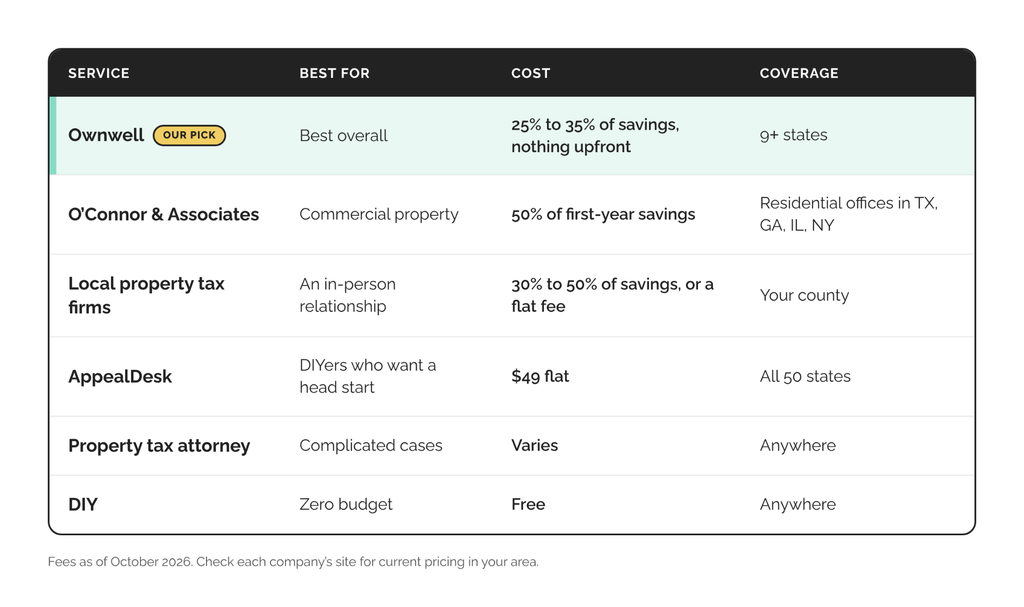
The Best Property Tax Appeal Services at a Glance
First, How These Services Get Paid
Almost every full-service appeal company works on contingency. You pay nothing upfront, and if they lower your bill, they keep a percentage of the savings.
That percentage is where the real differences show up. Here’s what a $1,000 reduction looks like at common rates:
- 25% fee: you keep $750.
- 35% fee: you keep $650.
- 40% fee: you keep $600.
- 50% fee: you keep $500.
Same win, different payout based on fees.
Watch for two other gotchas while you’re comparing. First, minimum fees can apply whether or not the appeal works. And auto-renewal clauses re-file for you every year, which is great, as long as you know it’s happening.
1. Ownwell: Best Overall
Ownwell is the one we use ourselves, and it’s the easiest recommendation on this list.
The Austin-based company launched in 2020 and runs the whole appeal for you from start to finish. It pulls comps, builds the evidence case, files before your deadline, and sends a local tax consultant to the hearings. Signing up takes a few minutes. After that, you basically just wait for an email.
Here are the deets:
- Fee: 25% to 35% of your savings, depending on your state. In Texas, New York, Illinois, and Washington (state) it’s 25%.
- Upfront cost: $0, with no minimum fee if the appeal doesn’t work.
- Coverage: Appeals in nine states (Texas, New York, California, Florida, Georgia, Illinois, Washington, Pennsylvania, and Colorado), plus help filing exemptions.
- If Ownwell doesn’t offer their full appeal service in your state or county, they do have free appeal packets that you can use for a DIY appeal.
- Results: Ownwell says 88% of its customers got a reduction on at least one appeal in 2025, and those who saved averaged $774 in savings.
When Ownwell compared Texas protest companies, competitors charged anywhere from 30% to 50%, and some tacked on minimum fees of $50 to $149. In New York, Ownwell also covers the $30 SCAR filing fee if a Nassau County grievance gets that far; most other firms don’t cover it
The results hold up, too. Ownwell pulled 2025 protest outcomes from appraisal district records in 11 major Texas counties and published them, broken out by home value. It beat other agents’ net savings in every value band in five of those counties, with mixed results in the other six.
Someone on the HTM staff used Ownwell for their rental duplex and saved $706 in a single year.
Keep in mind: Ownwell auto-renews by default. It’ll keep watching your assessment, re-file in any year it sees an opportunity, and charge its fee in any year it wins. If you’d rather opt out, cancel at least two months before your county’s deadline. And if you live outside its nine states, you might want to see if you qualify for their free national appeal packet..
2. O’Connor & Associates: Best for Commercial Property
O’Connor is the grandpa of the industry. The Houston firm has been fighting property tax bills since 1974. It has residential offices in Texas, Georgia, Illinois, and New York, and handles commercial property in 45 states.
But, the price tag is heftier. O’Connor’s residential fee is 50% of your first-year savings, so on that same $1,000 win, you’d hand over $500. Twice what Ownwell charges a Texas homeowner.
Where O’Connor shines is complexity. For higher-value properties, it can take a case all the way to binding arbitration or a lawsuit, and it says it saved clients more than $213 million in 2025. If you own an apartment complex or a strip mall, that firepower might justify the bigger cut. For a regular single-family house? Probably overkill.
3. Local Property Tax Firms: Best for an In-Person Relationship
Some folks just want a firm down the road, staffed by people who know the staff at the assessor’s office by name. No harm in that!
Most counties have a few of these shops, often run by former appraisers,ex-assessor staff, or local attorneys and CPAs. They know the local review board, and usually have some insight on what works and what doesn’t. That local knowledge is real, and for some homeowners a face-to-face relationship is worth paying for.
The pricing is where you need to pay attention. According to Ownwell’s guide to property tax consultants, regional firms typically charge 30% to 50% of your savings, or a flat fee of $200 to $500+. A flat fee means you pay whether the appeal is successful or not.
Some firms mix the two, with a contingency fee plus a minimum charge if your savings come in small. So, they basically get paid regardless of the effort.
Others bill on “projected” savings over several years instead of just the first one, which can make the final bill way bigger than it looked on paper.
Pro tip: Search “[your county] property tax consultant” and you’ll find the local options pretty quickly. Before you sign with any of them, ask:
- What percentage do you charge, and is it based on first-year savings only?
- Is there a flat fee or minimum charge if you don’t win?
- Do you charge anything upfront?
- Does the contract renew automatically, and how do I cancel?
- Can you share your success rate in my county?
And remember, you can always ask for a discount!
4. AppealDesk: Best for DIYers Who Are Willing to Pay $49
AppealDesk takes a different approach. For a flat $49, it builds you an evidence packet with comparable sales, a county-specific filing guide, and a cover letter. It works in all 50 states, and you keep 100% of whatever you save.
Just remember that when you file the appeal yourself, you show up to any hearings yourself. Think of it as a really good study guide, and you better have a fairly straight baseline knowledge of real estate and your local market.
If you’re comfortable presenting your own case (or you live somewhere the full-service companies don’t reach), $49 is a good deal. If the whole reason you’re reading this is that you never get around to filing, a packet sitting in your downloads folder won’t help much. 😅
5. A Property Tax Attorney: Best for Complicated Cases
Most homeowners will never need a lawyer for this. A standard residential appeal comes down to comps, photos, and a short hearing.
Some cases get gnarly, though. Big commercial buildings or multi-year disputes… that’s attorney territory. Fee arrangements vary widely (some work on contingency, others bill by the hour), so get the terms in writing before you sign anything.
If you’re being billed by the hour or on retainer, you’d better have a strong case!
6. Do It Yourself: Best Free Option
You can always appeal on your own, for free. You then keep the entire tax reduction.
It does take work. You’ll pull your property record card, gather three to five recent comparable sales, photograph anything wrong with the house, and show up to an informal meeting or a hearing. Plan on spending a few hours of your life, minimum.
If that sounds fun (no judgment, some of us are nerds about this stuff), our step-by-step guides for Texas and New York walk through the whole process.
And remember, Ownwell does offer a free national appeal packet for areas they don’t fully serve.
So Which One Should You Pick?
Here’s the quick version:
- You want it handled, and you live in one of Ownwell’s nine states: go with Ownwell.
- You own commercial property or a big portfolio: look at O’Connor or hiring an attorney.
- You want someone local you can meet in person: shop around your county’s firms, and read the fine print.
- You like doing things yourself but want help with evidence: try Ownwell’s free packet or AppealDesk.
- You have more time than money: DIY it.
Whatever you choose, the deadline is the boss. Most counties give you a short window after notices go out, and missing it usually means waiting a full year. Put it on your calendar the day your assessment arrives!
FAQs
Can appealing raise my taxes? In most states, nope. Ownwell flags Georgia and Washington as places where a value can go up, and it reviews the data before filing there.
Do I have to appeal every year? Your value gets reassessed regularly, so it’s worth a look every time. A service with auto-renewal handles that part for you.
Is a contingency fee worth it? If the alternative is never filing, absolutely. Paying 25% of a reduction you never would have gotten on your own still leaves you 75% ahead.
Are these services legit? The ones on this list are. Be wary of anyone asking for big money upfront with no explanation of what you get for it.
The Bottom Line:
Property taxes are sneaky. They don’t feel like a choice, so most of us never treat them like a bill worth negotiating. But your assessment is somebody’s estimate, made at scale, usually without anyone setting foot in your house. You’re allowed to question it.
The best appeal service is the one that actually gets your appeal filed. For most homeowners in the states it covers, that’s Ownwell: low fees, zero upfront cost, and published results to back it up. For everyone else, there’s a solid option on this list, all the way down to a free afternoon and a stack of comps.
Whatever you choose, just don’t let the letter sit on the counter again this year. 🏡